ATTO BIANCO
CREDITS
Progetto, coreografia, danza \ dance choreography project:
Roberta Racis
Suono e musiche eseguite dal vivo \ sound and music performed live:
Samuele Cestola
Collaborazione drammaturgica \ dramaturgical collaboration:
Martina Badiluzzi
Consulenza drammaturgica \ dramaturgical advice:
Dea Merlini
Disegno luci \ lighting design:
Giulia Pastore
Direzione tecnica \ technical direction:
Mattia Bagnoli
Set, scenografia \ set, scenography:
Cmf Scenografie
Costume \ costume:
Rebecca Ihle
Vocal coaching:
Alessandra Diodati
Cura dei testi \ text curatorship:
Gaia Clotilde Chernetich
Foto e video \ photo and video:
Luca del Pia
Produzione generale \ general production:
Pietro Monteverdi
Promozione, cura \ promotion, care:
Jean-François Mathieu
Produzione \ production:
Oscenica
In coproduzione con \ in co-production with:
Primavera dei Teatri, Fabbrica Europa
Con il sostegno di \ with the support of:
Inteatro Polverigi, Teatro Politeama Mario Foglietti
Fondazione Armunia, Operaestate Festival / CSC di Bassano del Grappa
ATTO BIANCO
I'm wandering in the fog
I'm wandering in the fog
An angry spirit
A wild dancer
I'm wandering in the fog
I'm wandering in the fog
An angry spirit
A wild dancer
Your baby girl
Freedom is nothing more than
the distance between
a hunter and his prey
a hunter and his prey
it is in this laminal space
that I wander
I'm wandering in the fog
I'm wandering in the fog
An angry spirit
A wild dancer
I'm wandering in the fog
I'm wandering in the fog
An angry spirit
A wild dancer
Your baby girl
An orphan
A wounded animal on the run
A wounded animal on the run
I was trying
I was trying to stand up
to listen to myself
I was trying to remember
How to walk, how to dance
I was trying not to listen the voices in my head
Voices in my head
Voices in my head
Dropping them like leaves
Dropping me like leaves
Dropping them like leaves
Dropping me like lives
Like leaves
Like leaves
In the wind
I’m wandering in the fog
I’m wandering in the fog
An angry spirit, a wild dancer, your baby girl
An orphan
Un animale ferito in fuga
Un animale ferito in fuga
Provavo
Provavo ad alzarmi
ad ascoltarmi
Provavo a ricordare
Come camminare, come danzare
Provavo a non ascoltare le voci nella mia testa
Voci nella mia testa
Voci nella mia testa
Lasciandole cadere come foglie
Lasciandomi cadere come foglie
Lasciandole cadere come foglie
Lasciandomi cadere come foglie
Come foglie
Come foglie
Nel vento
Vago nella nebbia
Vago nella nebbia
Uno spirito infuriato, una danzatrice sfrenata, la tua bambina
Un’orfana
Vago nella nebbia
Vago nella nebbia
Uno spirito infuriato
Una danzatrice sfrenata
Vago nella nebbia
Vago nella nebbia
Uno spirito infuriato
Una danzatrice sfrenata
La tua piccolina
La libertà non è altro che
la distanza tra
un cacciatore e la sua preda
un cacciatore e la sua preda
è in questo spazio liminale
che vago
Vago nella nebbia
Vago nella nebbia
Uno spirito infuriato
Una danzatrice sfrenata
Vago nella nebbia
Vago nella nebbia
Uno spirito infuriato
Una danzatrice sfrenata
La tua piccolina
Un’orfana
ITA\
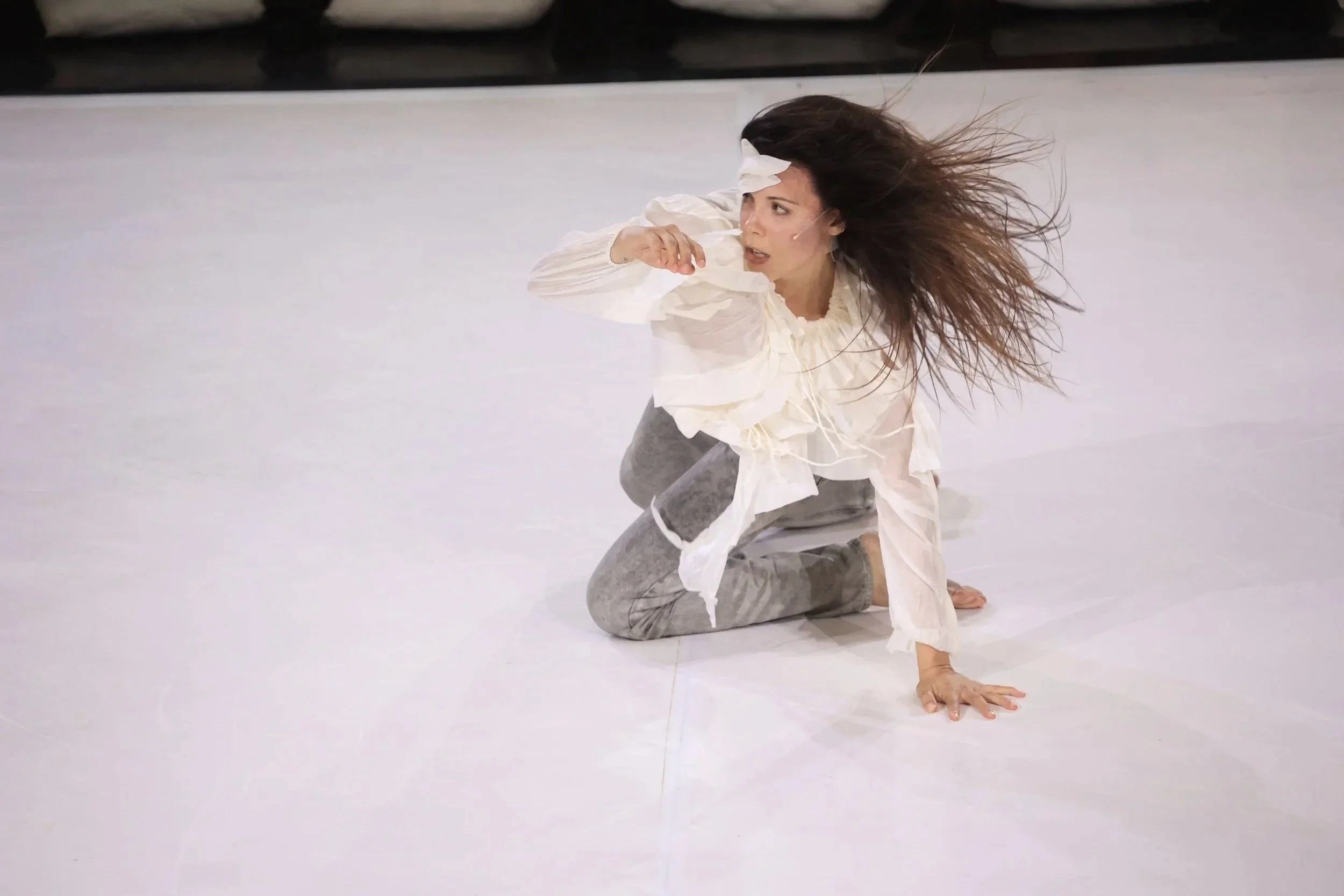
In Atto Bianco danza, voce e canto strutturano sinergicamente l’azione componendo un omaggio al materno e all’atto bianco del balletto romantico partendo da una riflessione sull’elaborazione del lutto. L’atto bianco è generalmente il secondo atto di spettacoli il cui libretto narra vicende a cavallo tra il mondo dei vivi e una dimensione ultraterrena. Si tratta di atti in cui, dopo la morte di un personaggio, solitamente femminile, l’aldilà si manifesta sotto forma di creature immateriali vestite di bianco ,che appaiono la notte e sono la rappresentazione di stati di coscienza alterati, di perdita di confine tra reale e immaginario, tra allucinazione e onirico, tra vita e morte. L’atto bianco si predispone, oggi, a un’indagine che riflette sul femminile facendo deflagrare l’approfondimento personale sulla fragilità e sul lutto in una serie più ampia di possibilità.
ENG\
In Atto Bianco dance, voice and song synergistically structure the action, composing a tribute to motherhood and the white act of romantic ballet, starting from a reflection on the processing of grief. The white act is generally the second act of shows whose libretto narrates events straddling the world of the living and an other worldly dimension. These are acts in which, after the death of a character, usually female, the afterlife manifests itself in the form of immaterial creatures dressed in white, who appear at night and represent altered states of consciousness, the blurring of the boundaries between reality and imagination, between hallucination and dream, between life and death. Today, the white act lends itself to an investigation who reflects on the feminine by exploding the personal exploration of fragility and mourning into a wider range of possibilities.